
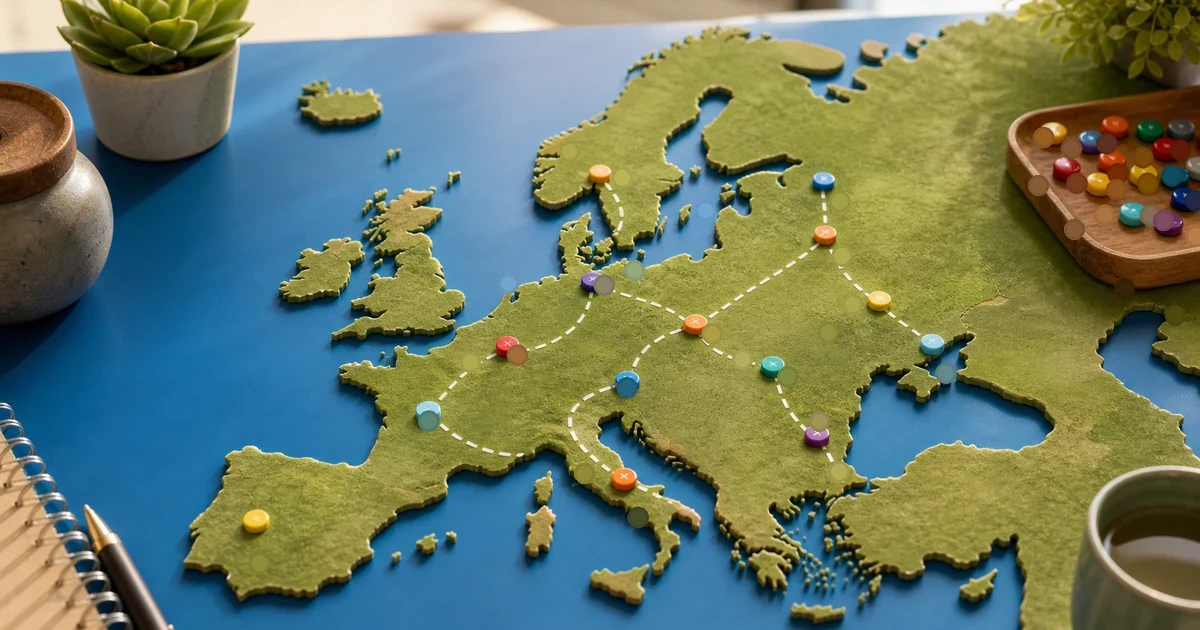
Europe minefield rewards patient map reading. The winning habit is simple: identify the regional cluster first, rebuild the missing border in your head, then click only when the neighboring shapes agree.
This guide is for players who already recognize many European countries but lose rounds on dense borders, small states, or overconfident clicks. Use it as a practice routine before moving into no-skip runs.
Practice with the Europe Minefield Geography Quiz
Start with Europe's natural clusters
Do not try to memorize Europe as one crowded shape. Break the map into clusters you can recognize instantly: Iberia, the British Isles, Scandinavia, the Baltics, Central Europe, the Balkans, and the eastern edge.
- Use coastlines first: Portugal, Italy, Greece, Norway, Denmark, Ireland, and Iceland give you strong anchors.
- Use corridors next: Belgium-Netherlands-Luxembourg, Austria-Hungary-Slovakia, and the Balkan chain need local spacing.
- Leave microstates and tiny coastal targets for slower clicks unless the prompt is completely obvious.
- When a country sits inland, locate the surrounding countries before placing the click.
The three-second click routine
A fast click is useful only after the location is certain. For difficult prompts, take three seconds: name the cluster, name two neighbors, then choose the center of the country rather than the border.
That routine prevents the classic Europe minefield mistake: clicking where the visible outline would be, not where the hidden country actually sits.
High-risk Europe minefield zones
Most lost rounds come from a few compact areas. Treat them as separate drills rather than random mistakes.
- Benelux: Belgium, Netherlands, and Luxembourg require exact spacing, not just a general western Europe click.
- Baltics: Estonia, Latvia, and Lithuania are easier when you read them north to south along the Baltic Sea.
- Central Europe: Czechia, Slovakia, Austria, Hungary, Slovenia, and Croatia overlap mentally unless you rebuild the neighbor chain.
- Balkans: Bosnia and Herzegovina, Serbia, Montenegro, Kosovo, Albania, and North Macedonia reward slow neighbor checks.
- Small states: Andorra, Monaco, San Marino, Liechtenstein, Malta, and Vatican City should never be rushed.
Review Europe with visible-border practice
Use skips as information, not escape
Skipping is useful when two targets feel equally plausible. Do not treat a skip as failure; treat it as a note that the pair needs a focused review after the round.
If you skip Latvia twice, practice the Baltic order. If you skip Slovenia and Slovakia, practice the Central Europe chain. The goal is to turn every hesitation into a small drill.
When to switch to no-skip
No-skip mode is useful after your mistakes become rare and specific. If you still guess in the Balkans or Central Europe, stay in regular minefield until you can explain each click before making it.
Add flags and capitals carefully
Europe minefield flags and capitals add a second layer: first identify the country from the clue, then locate it without visible borders. Use those modes after the base map feels reliable.
Explore all Europe geography quizzes
Final takeaway
The best Europe map minefield strategy is not speed. It is controlled certainty: cluster first, neighbors second, center click last. Speed comes later because the map becomes familiar.