
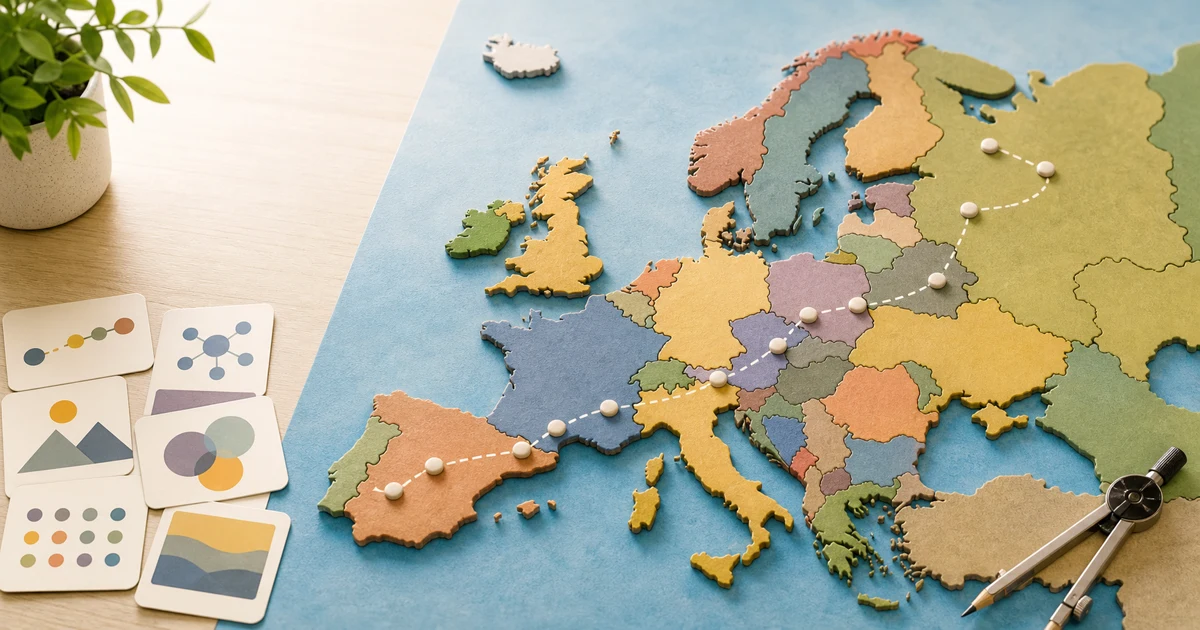
The easiest way to learn the countries of Europe is not to memorize one long list. Start with a clear order, place each group on the map, then use short quizzes to test what you can recall without hints.
A good routine is: learn the big regional clusters first, add the smaller countries second, review common mix-ups third, and finish each session with active map practice.
A useful order for learning Europe
Europe becomes much easier when you learn it in zones. Begin with the large, familiar anchors, then move toward smaller regions where many countries sit close together.
- Start with the west and center: Portugal, Spain, France, Belgium, the Netherlands, Luxembourg, Germany, Switzerland, Austria, and Italy.
- Add the north: Iceland, Ireland, the United Kingdom, Denmark, Norway, Sweden, Finland, Estonia, Latvia, and Lithuania.
- Move east: Poland, Czechia, Slovakia, Hungary, Slovenia, Croatia, Romania, Bulgaria, Moldova, Belarus, Ukraine, and Russia.
- Finish with the south and microstates: Greece, Albania, Montenegro, Bosnia and Herzegovina, Serbia, Kosovo, North Macedonia, Malta, Andorra, Monaco, San Marino, Vatican City, and Liechtenstein.
Warm up with the Europe Find 10 Countries quiz
Use the map before the list
A list tells you that Slovenia and Slovakia both exist. A map shows why they are easy to confuse and how to separate them: Slovenia touches the Adriatic region near Italy and Croatia; Slovakia sits inland between Czechia, Poland, Ukraine, Hungary, and Austria.
For each new group, look for coastlines, peninsulas, islands, mountain arcs, and neighbors. These visual hooks are stronger than repeating names without context.
Memory tips that actually help
Good memory tips are simple and visual. They should point you back to the map, not replace it. Use them for the countries that keep slipping.
- Baltic order north to south: Estonia, Latvia, Lithuania. Think of the coastline as a short vertical stack.
- Benelux west to east: Belgium, Netherlands, Luxembourg. Keep Luxembourg as the small inland country next to Belgium.
- Scandinavia: Norway curves along the Atlantic, Sweden sits beside it, Finland is farther east.
- Iberia: Portugal is the Atlantic strip on the west, Spain fills most of the peninsula.
- The Adriatic chain: Slovenia, Croatia, Bosnia and Herzegovina, Montenegro, and Albania are easier when you follow the coast downward.
Practice in three passes
First pass: identify countries with no pressure. Second pass: hide the list and find them on the map. Third pass: use a full quiz and write down only the names you missed.
This keeps practice focused. You do not need to restart from zero every time; you only need to bring weak countries back into the next round.
Common Europe mix-ups
Most mistakes are predictable. Learners often mix up Slovakia and Slovenia, Latvia and Lithuania, Kosovo and Montenegro, Moldova and Belarus, or the small countries around France and Italy.
When a pair is confusing, compare the neighbors. Neighbor patterns are usually more reliable than trying to remember a country shape in isolation.
A 15-minute study plan
- Minutes 1-3: review one region on the map.
- Minutes 4-8: cover the labels and recall the countries.
- Minutes 9-12: play a short quiz round.
- Minutes 13-15: write down mistakes and repeat only those countries.
Repeat a quick Europe country round
Explore all Europe geography quizzes
Final tip
Learn Europe as a map of connected regions. Once the order is clear and the memory hooks are tied to real locations, the country names stop feeling random.