
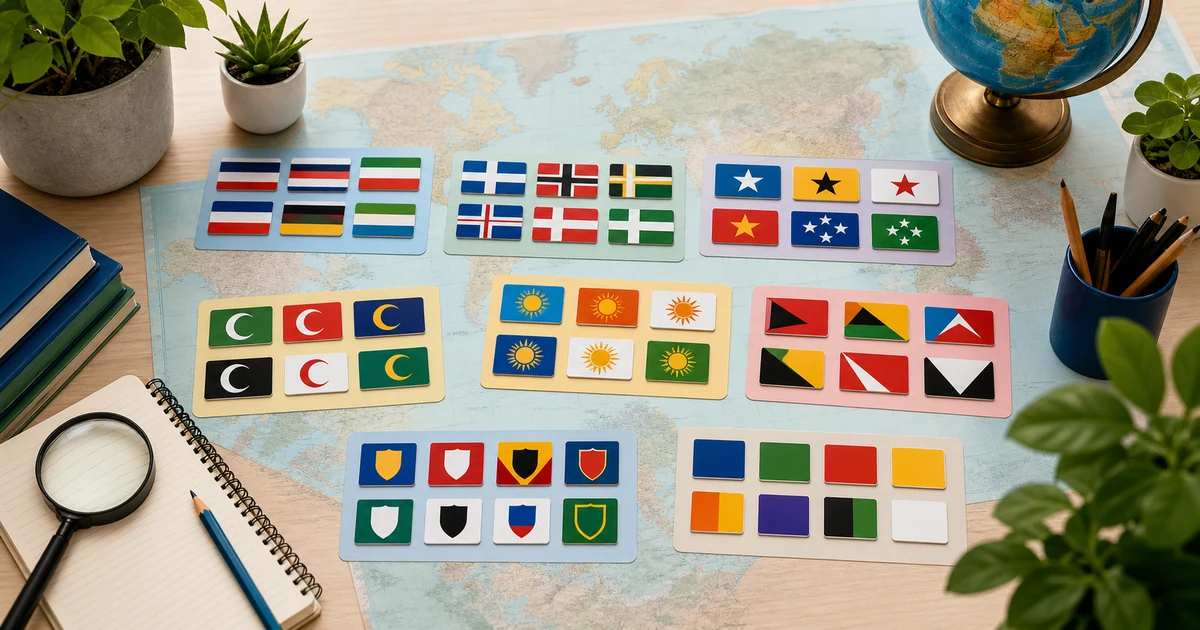
The easiest way to learn flags is not to memorize one flag at a time. First learn the common building blocks: stripes, crosses, stars, crescents, suns, triangles, coats of arms, and color families.
Once you can name the pattern family, every flag gives you fewer details to remember. You recognize the design type first, then use one or two clues to identify the country.
Start with the big flag patterns
Most flags use a small set of visual layouts. Tricolors use three bands, Nordic flags use an off-center cross, many island flags use a canton plus stars, and several flags add a triangle at the hoist.
- Horizontal stripes: look from top to bottom and say the color order aloud.
- Vertical stripes: read from the hoist side to the outside edge.
- Crosses: notice whether the cross is centered, offset, straight, or diagonal.
- Triangles and cantons: check their color, position, and whether they contain a symbol.
- Plain fields with symbols: focus on the exact symbol before studying small details.
Warm up with a short world flags quiz
What flag colors usually signal
Flag colors do not have one universal meaning, but they often point to shared history, geography, religion, or political movements. Green, yellow, red, black, white, blue, and red appear again and again because they belong to larger traditions.
Use color as a first sorting tool, not as the only answer. Green-yellow-red may suggest a Pan-African family, red-white-black-green may suggest a Pan-Arab family, and red-white-blue may point to several European or colonial-era traditions.
Symbols to recognize first
- Stars can show states, ideals, unity, constellations, or regional identity.
- Crescents often connect to Islamic heritage, but the exact color and placement still matter.
- Suns and rays often point to independence, geography, or a new era.
- Coats of arms carry local animals, shields, crowns, tools, or historic emblems.
- Birds, eagles, and condors are usually strong country-specific clues.
Practice all country flags of the world
Learn by flag families
Flag families make learning faster because they reduce hundreds of designs into memorable groups. Nordic crosses, Slavic tricolors, Pan-African colors, Pan-Arab colors, Central American blue-white-blue flags, and Oceania blue ensigns are useful starting points.
After you know the family, attach a country-specific detail: the number of stars, the coat of arms, the triangle color, the shade of blue, or the exact order of stripes.
Practice African flag colors and symbols
A 15-minute routine for learning flags
- Minutes 1-3: sort five to ten flags by pattern family.
- Minutes 4-7: say the color order and main symbol for each flag.
- Minutes 8-11: play a short flag quiz without pausing too long.
- Minutes 12-15: write only the missed flags and add one visual clue for each.