
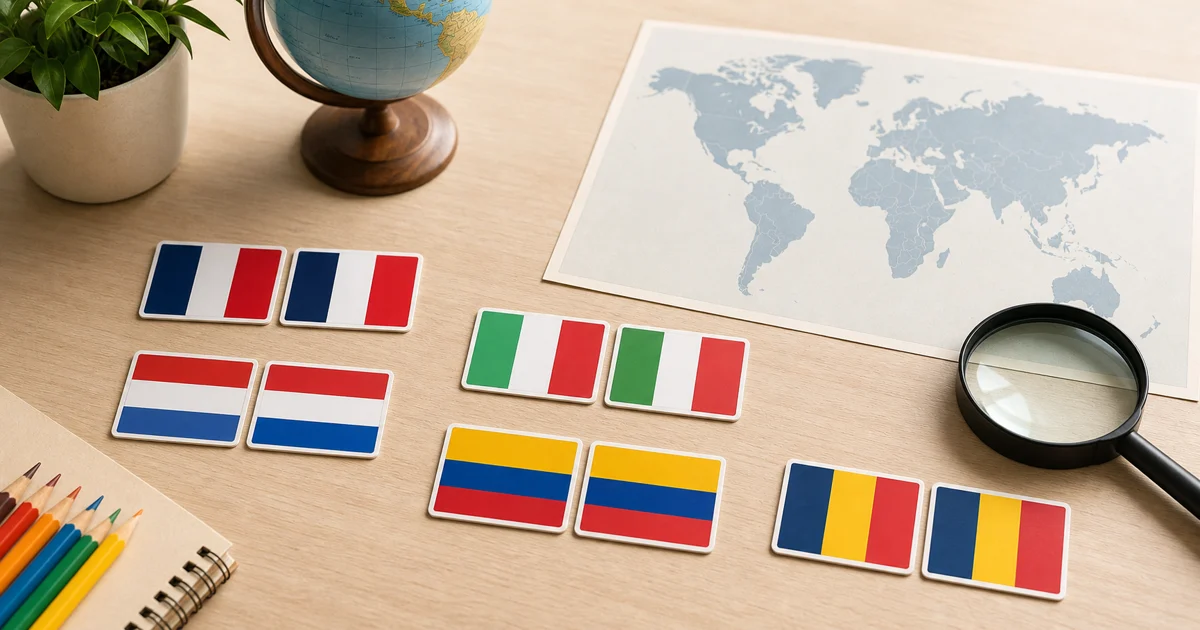
Similar flags are easiest to learn when you stop treating them as whole pictures and compare one detail at a time: stripe direction, color order, coat of arms, stars, crescents, triangles, and proportions.
The fastest method is to group confusing pairs, name the single difference out loud, then test yourself with short flag quiz rounds before the details fade.
Why so many flags look alike
Flags often share regional history, political symbolism, religious colors, or older design traditions. Pan-African colors, Pan-Arab colors, Nordic crosses, Slavic tricolors, and Central American blue-white-blue patterns all create families of flags that naturally resemble one another.
That makes confusion normal. The goal is not to memorize every flag from scratch, but to recognize which family it belongs to and then spot the detail that identifies the country.
Warm up with a quick world flags quiz
The visual checklist for similar flags
- Check stripe direction first: horizontal, vertical, diagonal, or cross.
- Read the color order from a fixed side, usually top to bottom or hoist to fly.
- Look for one added symbol: star, crescent, sun, shield, eagle, crown, or coat of arms.
- Notice the shape of triangles, crosses, disks, and emblems.
- Use geography as a memory hook: neighboring or related countries often share design families.
Common similar flag pairs
Romania and Chad are the classic example: both use vertical blue, yellow, and red stripes. The difference is subtle color shade, so it helps to connect Chad with a slightly darker blue and Romania with Europe.
Indonesia and Monaco both use red over white. Poland reverses the order with white over red. Austria also uses red and white, but adds a red-white-red stripe pattern.
Ireland and Côte d'Ivoire both use green, white, and orange vertical stripes, but the order is reversed. Ireland starts green at the hoist; Côte d'Ivoire starts orange.
Australia and New Zealand share a blue field, the Union Jack, and stars. New Zealand has red stars with white borders; Australia has white stars and the larger Commonwealth Star.
Practice the full world flags quiz
Flag families that cause mistakes
Some mistakes happen because whole regions reuse the same visual language. The Nordic countries use cross designs. Many Arab countries use red, white, black, and green. Several African countries use green, yellow, and red. Central American flags often use blue and white stripes.
When a flag belongs to a family, learn the shared pattern first. Then attach one country-specific clue: a coat of arms, a star count, a triangle color, a sun, or the exact stripe order.
Compare European country flags
Practice African country flags
A 10-minute study routine
- Minutes 1-2: pick five confusing pairs and say the difference aloud.
- Minutes 3-5: cover the country names and identify each flag by its clue.
- Minutes 6-8: play a short flag quiz round.
- Minutes 9-10: write only the flags you missed and add one visual clue for each.
Final tip
Do not try to remember similar flags by staring harder. Compare them deliberately, give each one a small visual clue, and return to quiz practice while the contrast is still fresh.